Why a Waistband That Feels Fine Standing Becomes Unbearable Sitting
Quick Answer: Sitting compresses your torso and pushes soft tissue forward, which can increase your waist circumference at the band’s position by two inches or more — so a band that sits at its comfortable tension standing is stretched well past it seated. Bands with a wide surface area and a high-recovery knit absorb that change; narrow, high-compression bands hit their limit and dig in.
If you test leggings standing in a fitting room, you’re testing the easy case.

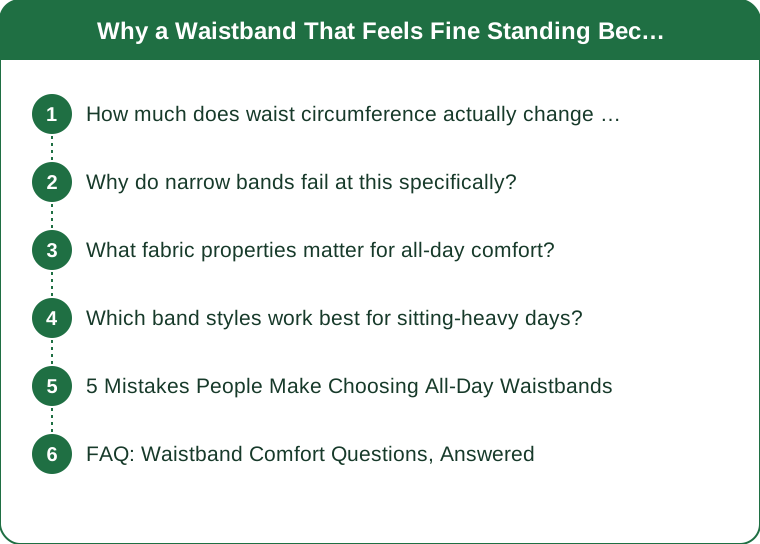
How much does waist circumference actually change when you sit?
More than people expect. When you sit, your hip flexors shorten, the pelvis rotates, and abdominal tissue redistributes forward — the combined effect commonly adds one to three inches at the level where a high-rise band sits.
That’s a large change relative to a waistband’s working range. A band sized to fit comfortably at your standing measurement may be near the top of its stretch range before you’ve done anything at all. Add a full day of sitting, plus the normal circumference variation that comes with eating and hydration, and a band with no margin becomes uncomfortable within a couple of hours.
Why do narrow bands fail at this specifically?
A narrow band concentrates its holding force into a small vertical span, so when circumference increases, all of the extra tension is carried by that thin strip. Pressure equals force divided by area, and a narrow band has very little area.
A wide band spreads the same increase across three or four inches of contact, which lowers the pressure at any single point substantially. This is why a wide band can feel comfortable at a tension that would be painful in a narrow one — it isn’t holding less, it’s distributing more. The same principle explains why a wide band is also less likely to leave a mark after a long day.
What fabric properties matter for all-day comfort?
Recovery matters more than stretch. A band that stretches easily but recovers slowly will accommodate sitting comfortably and then be loose when you stand — which means it’s sliding all day.
High elastane content with good recovery handles the repeated cycle of sitting and standing without either digging in or loosening. The other property worth checking is whether the band’s stretch is genuinely two-directional — some bands stretch horizontally but not vertically, and vertical stretch is what lets a band accommodate the pelvis rotating when you sit. A band that only stretches in circumference will fold rather than flex.

Which band styles work best for sitting-heavy days?
A wide flat band, three inches or more, in a high-recovery knit is the most reliable general-purpose choice — enough area to distribute pressure and enough recovery to handle repeated cycles.
A crossover or V-front band is often better still for long seated periods, because the relaxed outer edges give the abdomen somewhere to expand without the band having to stretch uniformly. Ribbed bands are a middle ground: the rib structure provides more give than a flat knit at the same weight. What to avoid is a narrow band with a rigid inner elastic strip — that strip has almost no stretch, so it becomes the limiting factor the moment you sit.
5 Mistakes People Make Choosing All-Day Waistbands
1. Testing only while standing. Sit down, lean forward, and stay there for 30 seconds before deciding.
2. Choosing maximum compression for comfort. Compression is for support during activity; all-day wear wants distribution instead.
3. Ignoring rigid inner elastic. A hidden non-stretch strip inside the band caps its range regardless of how stretchy the outer fabric is.
4. Buying for your morning measurement. Circumference genuinely varies through the day; a band with no margin will cross its limit.
5. Assuming a drawstring adds comfort. It adds adjustability at one moment, but a cinched drawstring concentrates pressure at the tie point.
FAQ: Waistband Comfort Questions, Answered
Does a wide waistband look bulkier under tops?
Under a very fitted top, slightly — a wide band creates a longer transition. Under most tops it actually looks smoother than a narrow band, which creates a sharper edge.
Is a fold-over waistband a good option for sitting?
Often yes, since folding effectively widens the band and softens the top edge. The tradeoff is less hold during activity.
Do compression leggings work for desk days at all?
Moderate compression is fine; high compression is designed for active use and typically becomes uncomfortable over several sedentary hours.
TL;DR:
- Sitting can add one to three inches at the waistband’s position — that’s the real test condition
- Wide bands distribute the extra tension; narrow ones concentrate it and dig in
- Recovery matters more than raw stretch, and vertical stretch matters as much as horizontal
- Watch for rigid inner elastic strips, which cap the band’s range regardless of the outer fabric
Test seated, not standing. It’s the position most of us spend the day in and the one almost nobody tries on.
See It in Motion
Seen here: High Waist 8” Yoga Shorts — shop similar styles on bubblelime.com
Keep Reading
This article is for general informational and styling purposes only. Fit, sizing, and product availability may vary.