Why Waistbands Feel Different Once You Start Layering
Quick Answer: A waistband sits comfortably when it holds position through even friction against a stable surface. Add a tucked shirt, a base layer and a thicker knit, and three things change: the effective circumference goes up by an inch or more, the band now grips fabric instead of skin so it slides and rides, and the extra bulk bunches into ridges that concentrate pressure in a few spots instead of spreading it. The fix is a wider band, a smooth base layer, and a front-only tuck rather than a full one.
The trousers were perfectly comfortable in August.
They are the same trousers, and in October they spend the whole day migrating upward and digging in on one side.

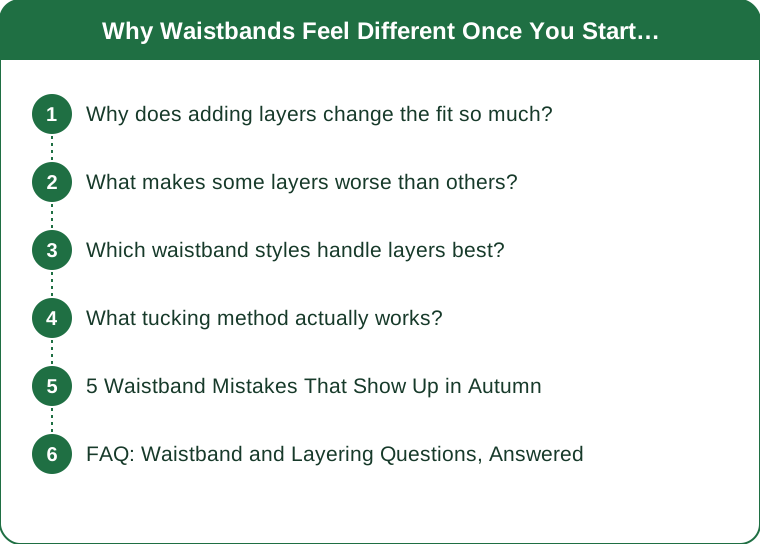
Why does adding layers change the fit so much?
Every layer adds circumference. A base layer and a shirt tucked in can easily add an inch or more at the waist, which is a full size in most trouser sizing.
The band loses its grip surface. Against skin or a smooth base layer it holds; against a bunched cotton shirt it slides with every movement.
Bulk does not distribute evenly. Fabric gathers at the sides and the front, producing thick spots where pressure concentrates and thin spots where the band gaps.
Those thick spots are where the digging happens, which is why the discomfort is usually in one or two specific places rather than all the way around.
And a band that slides rides upward, which puts it on a narrower part of the torso where it feels tighter still.
None of which is a sizing problem in the trousers. It is a stack problem.
What makes some layers worse than others?
Thick cotton shirts are the worst offenders, because they bunch into folds rather than lying flat and they hold every crease.
Smooth, thin base layers are the best, since they give the band a stable low-friction surface without adding bulk.
Ribbed and textured fabrics create ridges that the band presses into.
Anything with a side seam allowance or a hem at waist level doubles the thickness in one line, which is a specific and avoidable pressure point.
Fabrics that do not stretch fight the band when you sit, since something has to give and it will not be the shirt.
And layer order matters - the smoothest fabric closest to the band is the general rule.
Which waistband styles handle layers best?
Wide bands, always. More surface area means the same holding force spreads across more skin, which is the whole mechanism.
Elasticated or partly elasticated bands accommodate the extra circumference without moving to a larger size.
Higher rises sit at the natural waist, which is the narrowest point and where a band is least likely to slide down or roll.
Bands with a smooth inner face rather than exposed elastic, which grips fabric unpredictably.
Avoid narrow rigid bands with a hook closure under layers, since they concentrate force in the smallest possible area at the front.
And a band with a small amount of vertical structure - a facing or a light interfacing - holds its shape rather than folding over on itself.

What tucking method actually works?
The front tuck - shirt tucked at the front only, loose at the back and sides - removes most of the bulk while keeping the waist defined.
A full tuck needs a thin, smooth shirt, otherwise you are asking the band to hold a bundle of fabric in place.
Shirt stays or a base layer with a longer body stop the untucking that starts the whole cycle.
Tuck the base layer, leave the mid layer out, which is generally the better arrangement for both comfort and proportion.
Check it sitting down, since a tuck that is neat standing bunches at the front when you sit and that is where it digs.
And re-tuck after sitting rather than pulling from the hem, since pulling drags the band down with the fabric.
5 Waistband Mistakes That Show Up in Autumn
1. Keeping your summer size through the layer change. An inch of added circumference is a full size. It is not a reason to buy new trousers, but it is a reason to pick the ones with a wider or partly elasticated band for layered days.
2. Tucking a thick shirt fully. Thick cotton bunches into folds that become pressure points. A front tuck, or a thin base layer tucked with the shirt left out, solves it entirely.
3. Wearing tights and a waistband at the same height. Two bands stacked at the same point on the torso is the most common source of autumn waist discomfort, and offsetting them by even an inch makes a large difference.
4. Sizing down because the band feels loose standing. A band assessed standing in a fitting room will feel very different sitting, after lunch, with a base layer under it. Standing looseness is not the measurement that matters.
5. Ignoring where the seams land. A trouser side seam, a shirt hem and a tights band all meeting at one point creates a thickness the band cannot spread. Moving any one of them fixes it.
And the bonus: blaming your body for a stack problem. The waist that was comfortable in a single layer in August is the same waist. What changed is that there are now three fabrics competing for the same inch of space.
FAQ: Waistband and Layering Questions, Answered
Should I size up for winter?
Not usually. Choosing styles with a wider or partly elasticated band handles the extra layer without a size change and keeps the fit right on single-layer days.
Why does the band dig on one side only?
Almost always a bunched fold or a stacked seam in that spot. Smoothing the layer or shifting the tuck resolves it.
Are high-rise trousers better with layers?
Generally, because they sit at the natural waist where the torso is narrowest, which reduces sliding and rolling.
How do I stop tights and trousers fighting each other?
Offset the two bands vertically, and choose tights with a wide flat band rather than a narrow elastic one.
Does a belt help or hurt?
A belt over a bunched tuck concentrates the problem. Over a smooth front tuck it can hold everything in place and help.
What is the single best change?
A smooth thin base layer tucked in, with everything else left out. It gives the band a stable surface and removes almost all the bulk.
TL;DR:
- Layers add an inch or more of circumference and replace skin grip with fabric grip.
- Bulk bunches into ridges that concentrate pressure, which is why it digs in one or two spots.
- Wide, partly elasticated, high-rise bands handle layered days best.
- Front tuck, or tuck a thin base layer and leave the shirt out.
- Offset tights and trouser bands vertically instead of stacking them.
The trousers are fine. The stack is the problem.
Keep Reading
This article is for general informational and styling purposes only. Fit, sizing, and product availability may vary.