Why a Drawstring Stops Holding — and What Actually Fixes It
Quick Answer: Most drawstrings fail for one of three reasons: the cord is too slippery for the knot you are tying, the elastic underneath has lost recovery so the waistband no longer holds its own shape, or the channel is too wide and the cord simply slides sideways instead of gathering. Only the first one is fixed by tying it tighter — and that is the one people always try first.
You pull the cord, tie a bow, and it feels secure.
By mid-morning the waistband has migrated down, the bow is still tied, and the cord ends are noticeably longer than they were.
The knot held. The waistband gave.

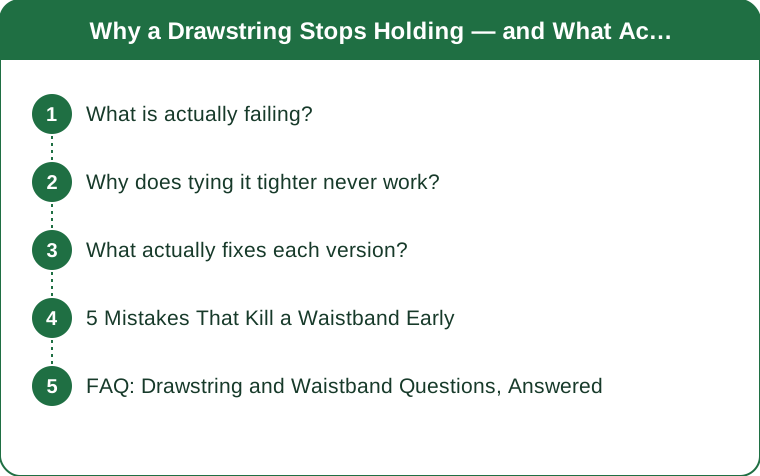
What is actually failing?
Three different failures produce identical symptoms, which is why the same fix does not work for everyone.
The cord is slipping through the fabric, not the knot. Flat woven cords with a slick finish — the ones on most performance joggers — have very low friction against a smooth nylon channel. You cinch the waistband, and over an hour of movement the fabric gradually slides back through, letting the gather out. The bow stays tied the whole time. This is the most common version and the easiest to diagnose: if the cord ends get longer while the bow stays intact, this is yours.
The elastic has lost recovery. Most drawstring waistbands have elastic in the channel too, and the cord is only meant to fine-tune it. Once that elastic has been through a hundred hot washes and a few dryers, it holds a fraction of its original tension. The cord is now doing a job it was never designed to do alone. Diagnose it by stretching the waistband and letting go — if it does not snap back, the elastic is done.
The channel is too wide for the cord. A narrow cord in a wide channel gathers the fabric unevenly and lets it redistribute as you move. This is a design shortcut in cheaper garments, and it shows up as bunching in one spot and slack in another.
Why does tying it tighter never work?
Because you are increasing tension on a system that is failing at the friction end, not the tension end.
A tighter knot does not change how much friction there is between cord and channel. It only means the cord travels further before you notice. And a harder cinch concentrates the gather in a smaller area, which usually makes the bunching-and-digging problem worse before the waistband slips anyway.
There is a second issue. A slick flat cord tied in a standard bow is genuinely poor at holding — the loops slide against each other under repeated small movements. What feels tight when you tie it is not tight after two hundred steps.
So the useful reframing is: this is a friction problem, and the solution is to add friction somewhere — in the knot, in the cord, or in the channel.

What actually fixes each version?
Match the fix to the failure.
For a slipping cord — change the knot. A surgeon’s knot — a standard bow with an extra pass on the first tie — is the single highest-return change here, takes one extra second, and holds slick cord far better than a normal bow. If you want something permanent, tie a stopper knot in the cord on each side of the channel exit so the cord physically cannot retract past it.
For a slipping cord — or change the cord. Swap a flat slick cord for a round braided cord or a flat cotton twill tape. Feeding a new cord through takes about five minutes with a safety pin and costs a couple of dollars. This is the fix people skip and the one that solves the problem permanently.
For dead elastic — replace the elastic, or accept it. Replacing waistband elastic is a genuine sewing job. The realistic alternatives are a stopper knot to make the cord carry the load, or a tailor doing it for you. Elastic that has died from heat is not coming back.
For a wide channel — add a stitch. A few hand stitches through the channel at the center back, catching the cord, stops it sliding sideways and keeps the gather even. It is invisible from the outside and it takes five minutes.
Prevent the next one: wash cold, hang dry. Heat is what kills elastane in waistband elastic. This roughly doubles how long a waistband holds its shape, and it costs nothing.
5 Mistakes That Kill a Waistband Early
1. Tumble drying everything. Heat degrades elastane faster than any other single factor. A waistband that lasted two years on a hang-dry routine can be shot in six months on high heat.
2. Pulling the pants on and off by the waistband. Yanking a garment over the hips with the elastic fully extended repeatedly overstretches it past its recovery range. Pull from the fabric below the band instead.
3. Cutting the cord shorter to stop it dangling. Once the ends are short, the cord retracts fully into the channel the first time it slips, and re-threading it is genuinely annoying. Tie stopper knots instead of trimming.
4. Using fabric softener. It coats fibers, which reduces friction — the exact property you need in a drawstring channel — and it degrades performance fabrics generally.
5. Sizing down and relying on the cord. A garment that only fits because the drawstring is cinched hard is a garment whose waistband is under constant maximum tension. It will fail early, and it will bunch while it does.
FAQ: Drawstring and Waistband Questions, Answered
What cord should I replace it with?
A round braided polyester or cotton cord, roughly 4 to 5mm, is the most reliable general choice. Flat cords look tidier and hold worse. Match the diameter roughly to the channel — too thin and it cuts into the gather, too thick and it will not feed through.
Is there a knot that never slips?
A surgeon’s bow covers most cases. For something you genuinely never want to retie, a stopper knot at each channel exit is the mechanical solution — the cord physically cannot go back in.
Why do some brands’ drawstrings never slip?
Usually a combination of a grippier cord, a narrower channel, and elastic that is actually doing its job. It is a design decision, not luck, and it is a reasonable thing to check before buying again.
Can I fix a stretched-out waistband without sewing?
Not properly. There are hacks — running a length of elastic through and knotting it, adding a button — but the honest answer is that stretched elastic is the one failure with no easy fix. Prevention through cold washing is what actually helps.
Does this apply to elastic-only waistbands too?
The elastic failure does, entirely. Cold wash and hang dry is the whole maintenance routine, and it is the difference between two years and five.
TL;DR:
- Three separate failures look identical: a slipping cord, dead elastic, or a channel too wide for the cord.
- If the cord ends get longer while the bow stays tied, it is friction — tying tighter cannot fix a friction problem.
- Fixes: a surgeon’s knot, stopper knots at the channel exits, or swapping a slick flat cord for a round braided one.
- Heat is what kills waistband elastic. Wash cold, hang dry, and stop pulling garments on by the band.
The knot was never the weak point. It was the two inches of cord quietly sliding back through the fabric all morning.
Keep Reading
This article is for general informational and styling purposes only. Fit, sizing, and product availability may vary.