Why Your Waistband Rolls Down Mid-Squat — and What Actually Stops It
Quick Answer: Squatting increases your waist circumference at the top of the band while decreasing it at the hip — so a band held up purely by tension slips downward at exactly the moment you brace. The fixes that work are a band with vertical structure rather than more stretch, a rise matched to your torso, and enough fabric grip at the hip. More compression alone usually makes it worse, not better.
Everything is fine through the warm-up. Then you hit depth on set three and the waistband decides to migrate south, and you spend the rest of the session hitching your leggings up between reps.
The instinct is to buy something tighter, and that is the wrong lever. The third section explains what to check before you spend anything.

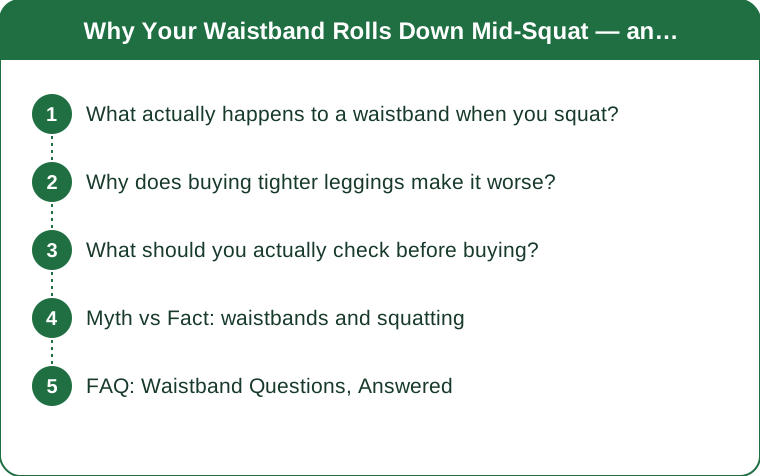
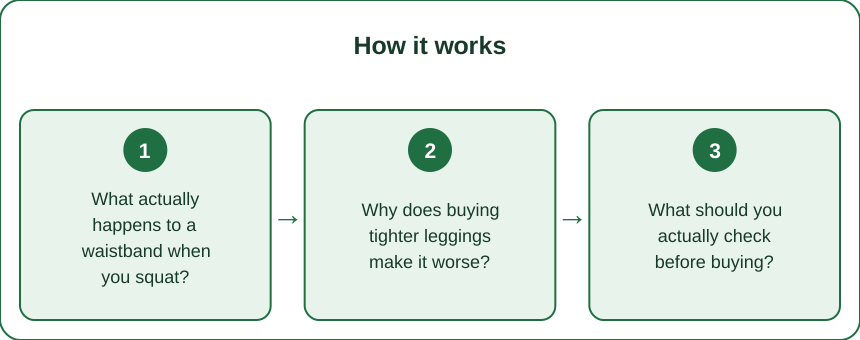
What actually happens to a waistband when you squat?
Three changes happen simultaneously, and together they defeat a band that relies on tension.
Your abdomen expands. A proper brace involves pushing outward against your entire abdominal wall — the 360-degree brace coaches talk about. Your waist circumference at band height genuinely increases, often by several centimeters, for the duration of the rep.
Your hip crease deepens and your glutes engage. Below the band, the fabric is being pulled downward and stretched across the largest range it will see all day. That pull is what drags the band down — the leg fabric is effectively tugging on the waistband every rep.
Your torso angle changes. Hinging forward shortens the distance from crotch seam to the front of your waist and lengthens it at the back. A band with a level, straight-cut top edge has to accommodate that by folding somewhere.
So the band is simultaneously being pushed outward from underneath, pulled downward from below, and asked to sit level on a torso that is no longer level.
A band that holds by squeezing has no answer to any of this. The tension that was sufficient standing is now applied to a larger circumference, which means it is proportionally looser at the exact moment the downward pull is strongest. That is the whole mechanism.
Why does buying tighter leggings make it worse?
Because you are increasing the wrong force, and adding a new problem.
Compression resists inward, not downward. A tighter band presses harder against your abdomen, which does nothing to stop the fabric below from pulling the band down. The failure is a shear force, and compression is a normal force — they are at right angles to each other.
Tighter bands create a bulge that starts the roll. When the band compresses tissue harder than the fabric above and below it, you get a defined ridge, and the top edge of that ridge is where a fold begins. Once a fold starts, it acts as a hinge, and every rep works it further.
Over-tight bands also restrict bracing, which matters for more than comfort. If a band prevents you from expanding your abdomen fully, you cannot brace properly, and bracing is the mechanism that protects your spine under load.
And there is a comfort cost that ends the session early — pressure at the ribs or a band digging in through 20 minutes of squatting is a genuinely miserable way to train.
What actually resists downward movement:
Vertical structure in the band. A band that is bonded, double-layered, or built from a firmer fabric resists folding because it has bending stiffness, not because it squeezes harder.
Friction at the hip and thigh. Fabric that grips slightly rather than sliding reduces the downward drag.
A rise that lands on stable tissue rather than above the natural waist.

What should you actually check before buying?
Five checks, none of which require a changing room.
Check 1: Pinch the band. Between thumb and finger. A band that folds instantly with no resistance will fold on your body too. One that has noticeable body and springs back is a bonded or multi-layer construction, which is what you want. This single test predicts squatting performance better than any spec sheet.
Check 2: Look for a contoured or V-shaped top edge. A band cut higher at the back and slightly lower or curved at the front follows what your torso actually does when you hinge. Straight-cut bands have to fold to accommodate the same movement.
Check 3: Measure your rise against your torso. Measure from your natural waist to your hip crease. If the stated rise puts the band above your natural waist and your torso is short, it will fold regardless of how good the band is. High-rise beats super-high-rise for squatting on most torsos.
Check 4: Check the fabric weight. Very lightweight, buttery fabrics are wonderful for yoga and are the most prone to sliding under load. A slightly heavier, denser knit grips better and holds shape through range. For squatting specifically, favor the more substantial fabric.
Check 5: Look for a drawcord — a real one. An internal drawcord is the only feature that directly resists downward movement rather than working around it. Many brands include a decorative cord that does not tighten anything. If it is functional, it is the most effective single feature available.
The test in the store: squat to full depth three times, then stand and check where the band is. Not one squat — three.
Myth vs Fact: waistbands and squatting
Myth: If it rolls, size down.
Fact: Sizing down is the most common wrong move. A smaller band applies more pressure to the same too-tall or too-soft construction, creating a firmer ridge that folds more decisively. Sizing down helps only if the pair is genuinely too big at the hip, which you can check: if there is loose fabric at the back of the thigh when standing, size is the issue. If the leg fits and the band rolls, size is not the issue.
Myth: Wider bands are always more secure.
Fact: Width without structure is just more material to fold. A 15 cm band of thin single-layer fabric performs worse than an 8 cm bonded one. Feel the band, do not measure it.
Myth: Squat-proof means the fabric is not see-through, so it will also stay up.
Fact: Completely unrelated properties. Opacity is about knit density and fabric thickness; staying up is about band construction and rise. A pair can be perfectly opaque and slide down every set.
Myth: A folded-over band is a sign of poor quality.
Fact: Sometimes it is a torso mismatch on a well-made garment. The same pair can behave impeccably on a longer torso and fold on a shorter one. It is a fit problem more often than a quality problem.
FAQ: Waistband Questions, Answered
Should I fold the band down on purpose for lifting?
It is a reasonable workaround. A deliberate, clean single fold sits flatter and more predictably than an accidental roll, and for many people it lands the band at a more comfortable height for bracing. The downside is reduced coverage. Treat it as a fix for a pair you already own rather than a reason to buy a too-tall rise.
Do lifting belts help or make the rolling worse?
A belt sits on the band and can hold it in place, which some lifters use deliberately. The complication is that a belt over a thick band changes where the belt pressure lands, and belt position matters for bracing. If you use a belt regularly, favor a thinner, structured band rather than a very thick one.
Is a high-waisted short better than leggings for heavy squatting?
Often, yes. Shorts remove most of the downward drag because there is far less fabric below the band being stretched across the knee and thigh. If you squat heavy and hate hitching your waistband, a well-built high-rise short is worth trying — a lot of people who assumed they had a waistband problem discover they had a leg-length drag problem.
TL;DR:
- Squatting expands your waist at the band while the leg fabric drags it downward — tension alone cannot fight that.
- Buying tighter increases compression, which is at right angles to the force actually pulling the band down.
- Pinch the band: real bonded or double-layer structure predicts performance better than any marketing term.
- Match rise to torso length, favor a slightly heavier fabric, and look for a genuinely functional drawcord.
- Test with three consecutive full-depth squats, not one.
The reason this is worth getting right is that hitching your waistband between reps is a small annoyance that quietly costs attention during the exact sets where attention matters. Fixing it is mostly about knowing that the fix is structure rather than squeeze — which also happens to be the more comfortable option.
See It in Motion
Seen here: Super High Waist Embossed Yoga Leggings with Inner Pocket — shop it on bubblelime.com
Keep Reading
This article is for general informational and styling purposes only. Fit, sizing, and product availability may vary.