Wide or Narrow Waistband? The Answer Depends on What You Are Doing
Quick Answer: A wide band (3 to 5 inches) spreads holding force over more surface, so it feels gentler and stays put better during movement — the right choice for sitting all day, lifting, and anything high-impact. A narrow band (1 to 2 inches) applies more pressure per square inch and sits lower on the torso, which suits shorter torsos, warm weather, and layering under fitted tops where a wide band would show. The mistake is treating width as a comfort ranking; it is a pressure-distribution choice with different right answers.

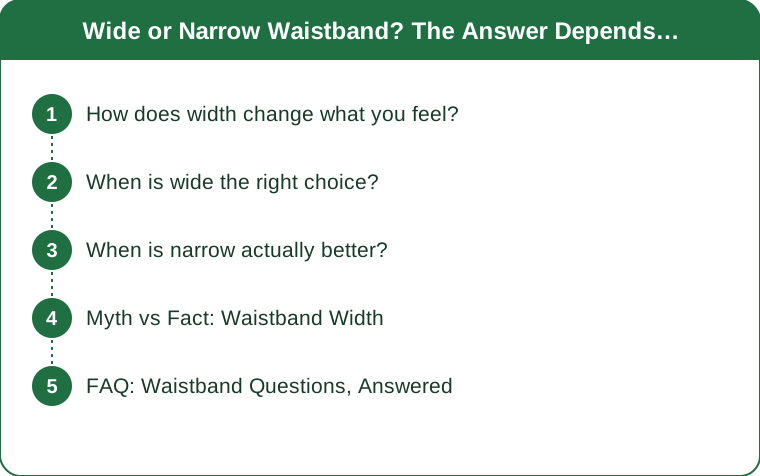
How does width change what you feel?
Pressure equals force divided by area. A waistband must apply a certain total force to stay in place. Spread that force over five inches of contact and the pressure at any point is low. Concentrate it into one inch and the pressure is several times higher for the same holding power.
That is why a wide band feels gentler while actually holding more securely — a counterintuitive but consistent result.
Width also changes where the top edge lands. A 5-inch band on a high-rise legging can reach the lower ribs, particularly on a short torso. A 2-inch band on the same rise stops well below. So width and rise interact, and you cannot evaluate one without the other.
Rolling behavior differs too. A narrow band under tension folds over easily, because there is little material resisting the fold. A wide band has more structure and resists rolling, though a wide band that does roll creates a much thicker fold.
And stability during movement favors width. A wide band contacts more of your torso, so there is more friction holding it against the same downward force. Narrow bands migrate more during running and jumping.
None of this makes one better. It makes them suited to different things.
When is wide the right choice?
All-day sitting. Desk work means hours of continuous contact, and pressure distribution matters more than anything else. A wide soft band is the clear winner here.
Lifting. A wide band stays put through hip hinges and squats, and it does not roll at the top when you fold forward. Many people also find the light abdominal contact reassuring during heavy sets, though it is not a substitute for a lifting belt.
Running and high-impact. More contact area means more friction resisting migration. A narrow band on a run is the classic case of pulling your waistband up every few minutes.
Postpartum and post-surgical comfort, where distributed gentle pressure is generally more tolerable than a concentrated line. Any specific medical situation is a question for your clinician, not a blog.
Cool weather. More coverage across the midsection.
The cases where wide goes wrong: a short torso with a very high rise, where a 5-inch band reaches the ribs, and under a fitted top, where the band’s top edge can show as a horizontal line. Both are placement problems rather than width problems, and a slightly narrower band or a lower rise fixes them.

When is narrow actually better?
Short torsos. If the distance from your natural waist to your hip bone is under 7 inches, a 5-inch band uses most of it. A 2 to 3 inch band sits comfortably in the same space.
Hot weather. Less fabric across the midsection, and the waistband is one of the sweatiest contact zones in any legging.
Under fitted tops and dresses. A narrow band creates a less visible transition. A wide band shows a distinct edge under thin fabric.
Layering. Two wide bands — a legging and a bike short, or a legging and a longline bra — stack into real bulk. A narrow band layers cleanly.
Yoga and floor work, where you fold at the hip constantly. Some people find a wide band bunches in deep forward folds and prefer a band that sits below the crease entirely.
Lower-rise styles generally, where a wide band would be structurally odd.
The requirement for a narrow band to work is good recovery. Because it applies higher pressure over less area, a narrow band that stretches out loses its grip fast and starts sliding. Wide bands are more forgiving of mediocre fabric; narrow bands are not.
Myth vs Fact: Waistband Width
Myth: Wider is always more comfortable. Fact: Wider distributes pressure better, which usually means more comfortable — unless the extra width reaches your ribs, in which case it is much worse.
Myth: A tight band holds better than a wide one. Fact: Tightness and holding power are not the same. Width plus recovery holds better than tightness, and with far less pressure.
Myth: Rolling down means the band is too tight. Fact: Rolling usually means the top edge is under more tension than the rest — often a rise mismatch with your torso rather than an overall sizing issue.
Myth: Folding a wide band down makes it a narrow band. Fact: It makes it a doubled band — twice the thickness at half the width, so pressure at the fold roughly doubles. It is the worst of both.
Myth: Drawcords make a band more secure. Fact: They add adjustability, but a cord tightened enough to hold creates the highest-pressure line of any design, plus a knot exactly where you fold forward.
FAQ: Waistband Questions, Answered
What width should I look for if I sit all day?
Three to four inches, soft inner face, bonded top edge. Confirm the top edge does not reach your lower ribs when seated — test by sitting for a full minute.
Why does my wide band roll only when I squat?
The top edge is being stretched more than the rest during hip flexion. Usually a rise slightly too high for your torso. A lower rise in the same width normally fixes it.
Do pocket waistbands change the comfort?
Slightly — a pocket adds a stiffer zone. It is minor when empty, noticeable when holding a phone, since the weight pulls that section down unevenly.
Is a seamless band better than a stitched one?
Generally yes for long wear, since there is no ridge in contact with skin. The tradeoff is that bonded bands can delaminate over many washes, while a stitched band tends to fail more gracefully.
TL;DR:
- Width is a pressure-distribution choice, not a comfort ranking.
- Wide (3 to 5 inches) for desk days, lifting, running, and cool weather — gentler pressure, better hold.
- Narrow (1 to 2 inches) for short torsos, heat, layering, and under fitted tops.
- Narrow bands require good recovery; they lose grip fast when the fabric tires.
- Never fold a wide band down — it doubles thickness and roughly doubles the pressure at the fold.
Most waistband complaints are a width-to-activity mismatch. Match the two and the band stops being something you think about.
See It in Motion
Seen here: Super High Waist Embossed Yoga Leggings with Inner Pocket — shop it on bubblelime.com
Keep Reading
This article is for general informational and styling purposes only. Fit, sizing, and product availability may vary.